TB-500 Wholesale
Thymosin Beta-4 fragment (17-43) — G-actin sequestration research tool, batch-documented, manufacturer-direct
Product Identity & Specifications
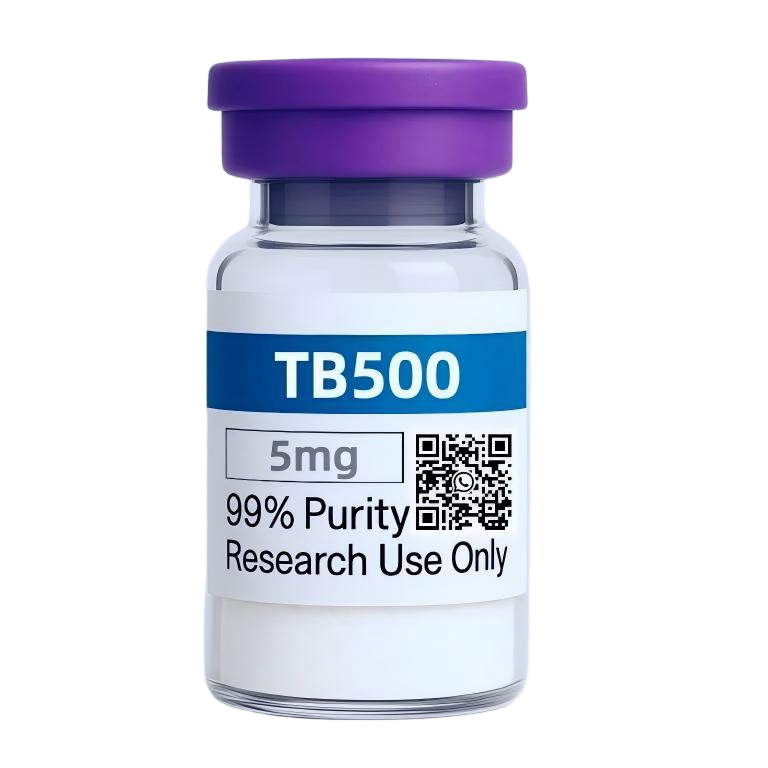
| CAS Number | 77591-33-4 |
| Sequence | Thymosin Beta-4 fragment (17-43) with actin-binding domain |
| Molecular Weight | ~4,963 Da (full Tβ4); fragment MW fragment-dependent |
| Appearance | White to off-white lyophilized powder |
| Purity | ≥99% by HPLC |
| Solubility | Freely soluble in sterile water or PBS |
| Storage | 2–8°C, desiccated, protect from light |
Available Configurations
| Configuration | Content | Best For |
|---|---|---|
| Standard Kit | 5 mg × 10 vials | Most research protocols |
| Bulk Kit | 10 mg × 10 vials | High-throughput; repeat buyers |
| BPC-157 + TB-500 Stack | 5mg + 5mg × 10 vials | Combined tissue repair research |
| Custom | Custom mg × custom vials | OEM; protocol-specific |
Research Background
Thymosin Beta-4 is a 43-amino acid peptide ubiquitously expressed in mammalian cells. TB-500 is its synthetic fragment containing the G-actin binding domain — making it a critical tool for cell migration and tissue repair research.
Published Research Focus Areas
Accelerated closure; reduced scar formation (collagen III:I ratio)
Keratinocyte & endothelial migration via G-actin remodeling
Endothelial differentiation; capillary tube formation
Anagen phase entry promotion
Reduced infarct size; improved function post-MI
Reduced NF-κB activation and TNF-α expression
Neurite outgrowth; excitotoxic damage protection
Proposed Mechanisms
TB-500 vs Full-Length Thymosin Beta-4
| Aspect | TB-500 | Full Tβ4 |
|---|---|---|
| Size | 17-43 fragment (~27 AA) | 43 amino acids |
| Actin-binding | ✓ | ✓ |
| Synthesis | Lower complexity | Higher (full 43-mer) |
| Research prevalence | Most common | Full-length mechanism studies |
| Cost | More economical | Higher |
| PSH availability | Standard | On request |
Quality Specifications
| Parameter | Method | Criterion |
|---|---|---|
| Purity | HPLC at 214 nm | ≥99.0% peak area |
| Identity (MW) | ESI-MS | Confirmed ±1.0 Da |
| Appearance | Visual | White to off-white powder |
| Peptide Content | AAA / nitrogen | ≥80% net peptide |
| Residual Moisture | Karl Fischer | ≤3% |
| Solubility | Sterile water test | Clear solution |
Tiered Wholesale Pricing
| Volume | Discount | For |
|---|---|---|
| 1 kit | List price | Evaluation; quality validation |
| 2–5 kits | 10–20% off | Small groups; initial stocking |
| 6–20 kits | 25–40% off | Mid-size distributors |
| 21–50 kits | 40–55% off | Regional distributors |
| 50+ kits | 55–70% off | Large distributors; recurring |
Combined ordering: Order BPC-157 + TB-500 together for combined volume discount — both count toward your tier.
FAQ
How does TB-500 differ from BPC-157 mechanistically?
TB-500 works via G-actin sequestration — binding monomeric actin to regulate cytoskeletal dynamics and cell migration. BPC-157 works via VEGF-mediated angiogenesis, GH receptor upregulation, and NO modulation. They are complementary: TB-500 mobilizes cells into wound sites; BPC-157 builds blood supply and growth factor environment. This is the mechanistic basis for their frequent combined use.
What's the recommended storage?
2–8°C, desiccated, protect from light. Powder is hygroscopic — reseal vials after opening. Stable 12–24 months. Post-reconstitution: aliquot into single-use portions in polypropylene tubes, freeze at -20°C. Avoid freeze-thaw cycles.
Can you provide full-length Thymosin Beta-4 (43-mer)?
Yes — available on request for protocols requiring the complete 43-amino acid sequence. Higher synthesis complexity and price vs. the TB-500 fragment. Contact us with your requirements.
Is TB-500 the same as Thymosin Beta-4?
Not exactly. TB-500 is the synthetic 17-43 fragment of Tβ4, containing the actin-binding domain. The full 43-mer may have additional N-terminal activities. For most tissue repair research, the TB-500 fragment is sufficient — it's the most commonly studied form.
FOR LABORATORY RESEARCH USE ONLY. Not for human or veterinary diagnostic, therapeutic, prophylactic, or any clinical use.
Ready to Source TB-500?
Tiered discounts up to 70%. COA with every order. Combined BPC-157 + TB-500 ordering available.