GHK-Cu Wholesale
Copper Tripeptide-1 — the most extensively studied copper peptide in dermatological research, batch-documented, manufacturer-direct
Product Identity
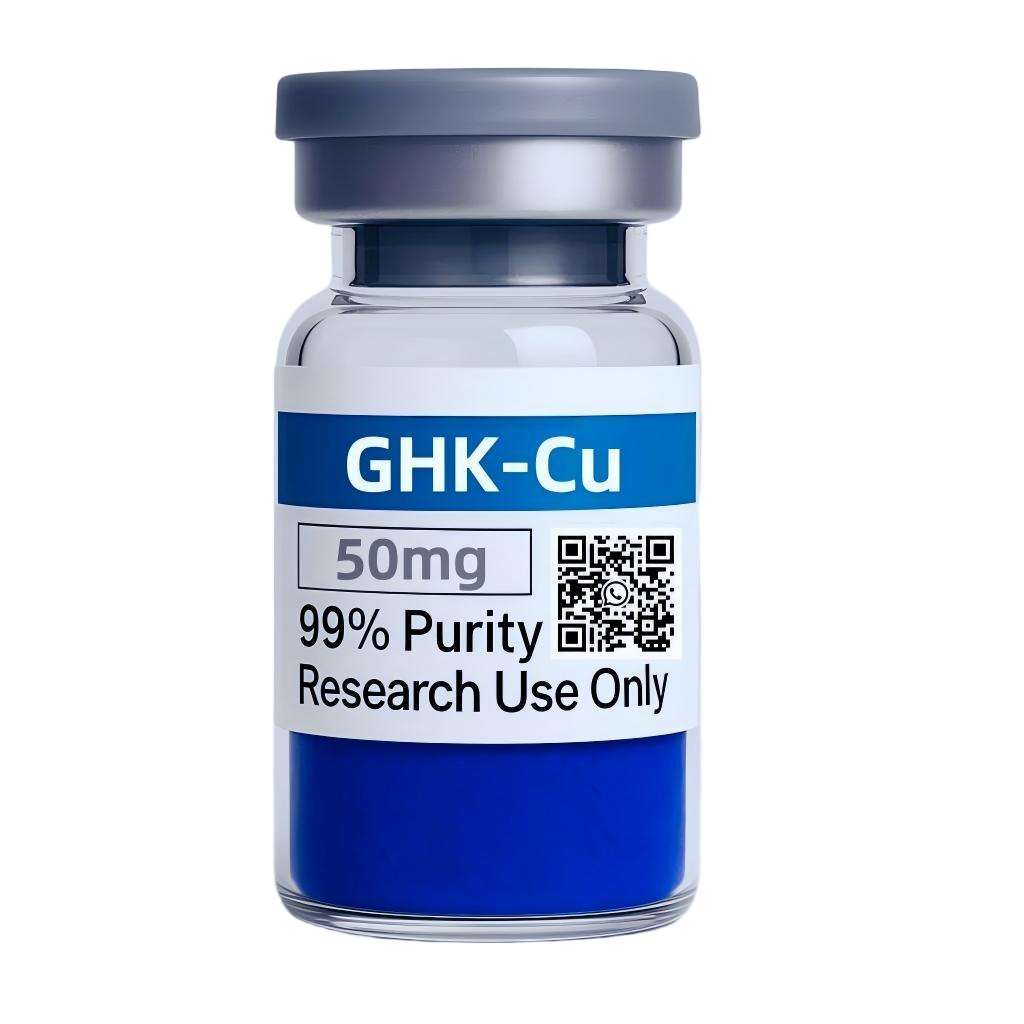
| CAS Number | 49557-75-7 |
| Sequence | H-Gly-His-Lys-OH complexed with Cu²⁺ (square-planar, log K ~16) |
| Amino Acids | 3 (tripeptide) |
| Molecular Weight | ~340.38 Da (free peptide) |
| Appearance | Blue to blue-purple lyophilized powder (Cu²⁺ complex) |
| Purity | ≥99% by HPLC |
| Solubility | Freely soluble in water or PBS |
| Storage | 2–8°C, desiccated, protect from light (light-sensitive) |
The GHK-Cu Complex: GHK binds Cu²⁺ in a square-planar geometry via four coordination bonds: N-terminal amine, Gly-His deprotonated amide, His imidazole, and His-Lys deprotonated amide. This tetradentate complex (log K ~16) remains intact under physiological conditions. The biological activities are attributed to the intact complex — not free copper or free peptide.
Configurations
| Configuration | Content | Best For |
|---|---|---|
| Standard Kit | 50 mg × 10 vials | Dermatological/cosmetic research |
| Bulk Kit | 100 mg × 10 vials | High-volume; formulation studies |
| Custom | Custom mg × custom vials | OEM; cosmetic ingredient supply |
Research Background
GHK was first isolated from human plasma in 1973 by Dr. Loren Pickart. The tripeptide has an exceptionally high affinity for copper(II) ions — the GHK-Cu complex is what drives its biological activities.
Research Focus Areas
Stimulates Type I, III, IV collagen in fibroblasts
Accelerated closure in full/partial-thickness models
Endothelial proliferation; capillary tube formation
SOD-like activity; ROS reduction
Upregulates decorin for collagen fibril organization
Reduces TNF-α and TGF-β1 in skin inflammation models
Dermal papilla cell proliferation; anagen phase extension
Increases epidermal thickness; dermal collagen density
Research Applications by Field
| Field | Application | Concentration |
|---|---|---|
| Dermatological Research | Fibroblast collagen synthesis | 1–10 μg/mL |
| Cosmetic Formulation | Topical formulation; transdermal penetration | 0.05–0.5% w/w |
| Wound Healing | Scratch assay; wound contraction | 1–100 μg/mL |
| Anti-Aging | Senescence markers; antioxidant capacity | Varies by model |
| Hair Research | Dermal papilla proliferation; follicle organ culture | 0.1–10 μg/mL |
Quality Specifications
| Parameter | Method | Criterion |
|---|---|---|
| Purity (HPLC) | HPLC at 214 nm | ≥99.0% peak area |
| Identity (MW) | ESI-MS | ~340.4 Da; Cu complex confirmed |
| Copper Content | ICP-OES / colorimetric | 1:1 Cu:peptide ±5% |
| Appearance | Visual | Blue to blue-purple powder |
| Peptide Content | AAA / nitrogen | ≥80% net peptide |
| Residual Moisture | Karl Fischer | ≤3% |
GHK-Cu analysis requires a dedicated HPLC gradient — the copper complex can interact with standard C18 stationary phases. Our method is optimized for copper-peptide purity determination.
Tiered Wholesale Pricing
| Volume | Discount | For |
|---|---|---|
| 1 kit | List price | Evaluation; protocol development |
| 2–5 kits | 10–20% off | Small cosmetic R&D labs |
| 6–20 kits | 25–40% off | Mid-size ingredient distributors |
| 21–50 kits | 40–55% off | Regional ingredient suppliers |
| 50+ kits | 55–70% off | Large formulators; OEM |
FAQ
Why is GHK-Cu blue? Is the color an indicator of quality?
The blue color is from Cu²⁺ in square-planar coordination — absorbing red light and reflecting blue. A blue to blue-purple powder = properly complexed copper. Faded or absent blue suggests copper loss or incomplete complexation. We verify with both color assessment and quantitative copper content (ICP-OES) to confirm 1:1 stoichiometry.
Is GHK-Cu stable in solution?
Stable in aqueous solution at neutral pH for several days at 4°C. The copper complex (log K ~16) remains intact. For quantitative cell culture: prepare fresh or aliquot and freeze at -20°C. Avoid chelating agents (EDTA, citrate) — they strip copper from the complex.
What's the difference between GHK and GHK-Cu?
Chemically distinct. GHK (free peptide, CAS 72957-37-0) lacks Cu²⁺ and doesn't exhibit the same biological activities. Virtually all published research uses GHK-Cu (the copper-complexed form). We supply GHK-Cu as standard. If you need copper-free GHK, specify in your inquiry.
Can GHK-Cu be combined with other cosmetic peptides?
Yes — commonly studied with Matrixyl (collagen), Argireline/Snap-8 (neurotransmitter inhibition). Peptides are chemically compatible. Expect blue tint in formulations — this is normal. Avoid strong chelators (EDTA) and reducing agents (high-concentration ascorbic acid) which disrupt the Cu complex.
FOR LABORATORY RESEARCH USE ONLY. Not for human or veterinary diagnostic, therapeutic, or clinical use. Not a cosmetic ingredient for consumer use, dietary supplement, or approved drug substance.
Ready to Source GHK-Cu?
Bulk pricing up to 70% off. Copper content verified by ICP-OES. COA with every order.