Retatrutide
Triple receptor agonist — the next frontier in multi-pathway metabolic research
Chemical Identity & Structure
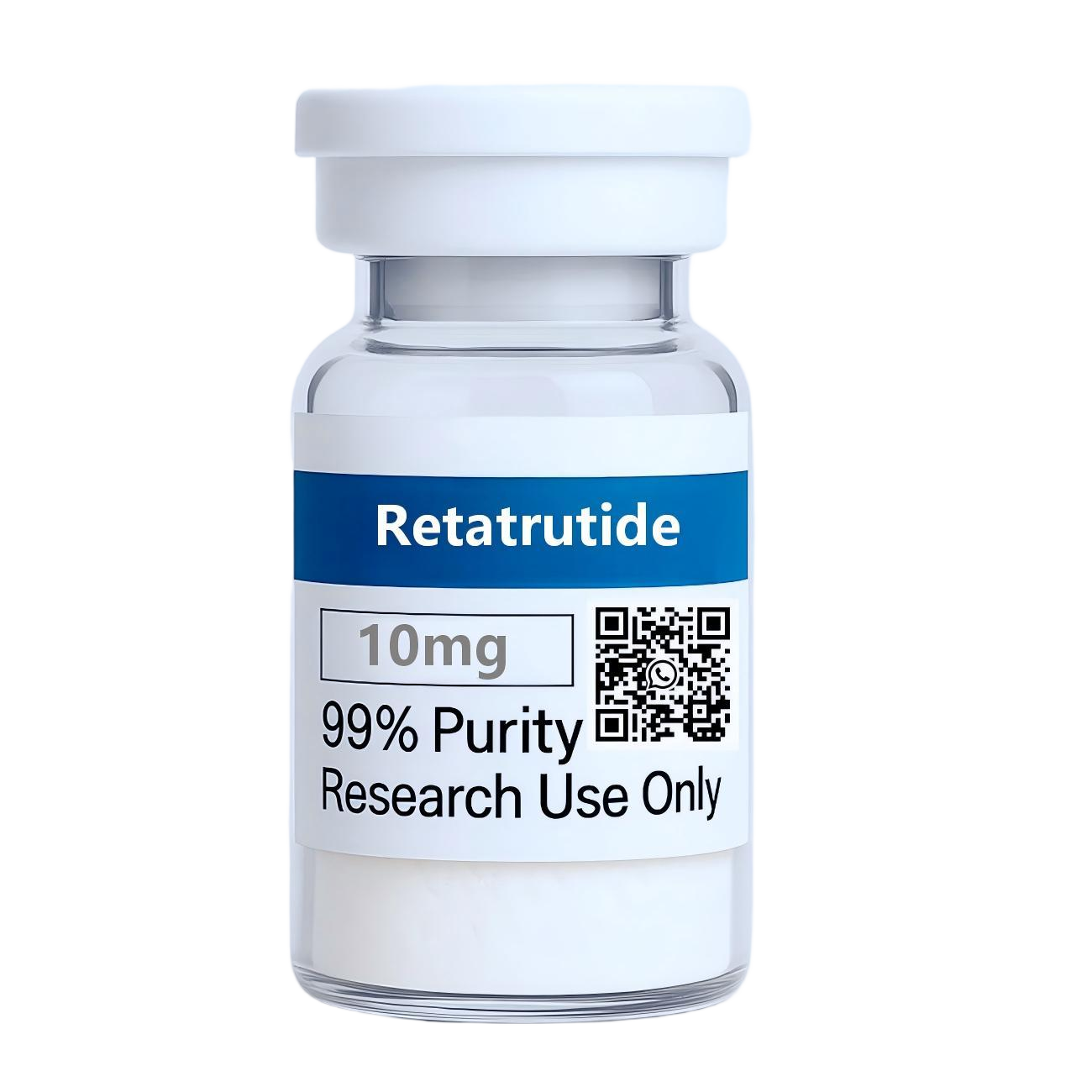
| Parameter | Value | Detail |
|---|---|---|
| CAS Number | 2381089-83-2 | GIP/GLP-1/GCGR triple agonist |
| Amino Acids | 39 residues | Single-chain peptide with engineered residue substitutions |
| Molecular Weight | ~4,845.5 Da | Confirmed by ESI-MS |
| Linker | C20 Fatty Diacid | Albumin-binding for extended half-life |
| Receptor Targets | GIPR · GLP-1R · GCGR | Triple agonism with balanced potency profile |
| Appearance | White Lyophilized Powder | Sterile-filtered, vacuum-dried |
| Storage | 2–8°C | Protected from light and moisture |
Available Configurations
5mg × 10 vials
Standard research format
PSH-RETA-5MG10mg × 10 vials
Higher-dose configuration
PSH-RETA-10MG15mg × 10 vials
Extended research format
PSH-RETA-15MGCustom Configuration
Custom dosing, labeling, packaging
Custom SKUAll configurations: lyophilized powder · 10 vials/kit · ≥99% HPLC · COA included
Research Background: Triple Receptor Rationale
Three Receptors, One Peptide
| Receptor | GIPR | GLP-1R | GCGR | Net Effect |
|---|---|---|---|---|
| Caloric Intake | Moderate ↓ | Strong ↓ (CNS) | Mild ↓ (hepatic FGF21) | Triple-redundant appetite suppression |
| Glucose Metabolism | ↑ Insulin sensitivity | ↑ Insulin secretion | ↑ Hepatic glucose output (acute); ↓ w/chronic | Net improvement in glucose homeostasis |
| Energy Expenditure | Minimal | Mild | ↑↑ via thermogenesis & lipolysis | GCGR uniquely boosts energy out |
| Lipid Metabolism | ↑ Lipid buffering in WAT | ↓ Hepatic lipogenesis | ↑↑ Lipolysis in WAT | Coordinated lipid mobilization |
The Key Insight
Most metabolic research tools address either "energy in" (appetite) or "energy out" (expenditure), but rarely both. Retatrutide's triple agonism bridges this gap: GLP-1R and GIPR primarily target caloric intake and nutrient partitioning, while GCGR activation drives energy expenditure through thermogenesis and lipolysis. The result is a single molecule that engages both sides of the energy balance equation — a concept that has generated significant interest from research groups studying comprehensive metabolic modulation.
Three Targets
GIPR, GLP-1R, and GCGR activation from a single 39-AA peptide chain
Energy Expenditure
GCGR component uniquely boosts thermogenesis — a mechanism absent in GLP-1-only agents
Balanced Agonism
Engineered potency ratios ensure no single receptor dominates — each contributes meaningfully
Structural Innovation
C20 fatty diacid linker confers extended half-life while maintaining triple-receptor activity
Quality Specifications
| Test | Method | Specification |
|---|---|---|
| Purity | RP-HPLC, C18 column, 220nm | ≥99.0% |
| Identity | ESI-MS | MW match within ±1 Da |
| Peptide Content | Amino Acid Analysis | 80–90% (net peptide) |
| Acylation Fidelity | LC-MS | Confirmed C20 diacid conjugation |
| Water Content | Karl Fischer | ≤8% |
| Trifluoroacetate (TFA) | Ion Chromatography | ≤1% |
| Appearance | Visual | White lyophilized powder |
Ongoing Stability Monitoring: Due to Retatrutide's structural complexity, each batch undergoes accelerated stability testing (25°C/60% RH, 14-day) in addition to standard release testing. Real-time stability data is accumulated across production lots and available on request.
Three Generations of Incretin-Based Research Tools
| Parameter | Semaglutide 1st Gen | Tirzepatide 2nd Gen | Retatrutide 3rd Gen |
|---|---|---|---|
| Receptor Targets | GLP-1R | GIPR + GLP-1R | GIPR + GLP-1R + GCGR |
| Body Weight Reduction* | ~15% | ~21% | ~24% |
| Energy Expenditure | Minimal | Minimal | ✓ Thermogenesis |
| Amino Acids | 31 | 39 | 39 |
| Synthesis Difficulty | Standard | Moderate | Complex |
| Manufacturer Count | Many | Several | Few |
* Body weight reduction data from published clinical study results at maximum doses. Individual results vary. For laboratory research reference only.
Bulk Pricing
Retatrutide's complex synthesis requires advanced manufacturing capabilities — only a limited number of global facilities can produce it at ≥99% purity. Tiered pricing reflects the technical investment behind every batch.
| Tier | Quantity | Typical Discount |
|---|---|---|
| Tier 1 | 1–3 kits | Base price |
| Tier 2 | 4–9 kits | 10–25% off |
| Tier 3 | 10–24 kits | 25–40% off |
| Tier 4 | 25–49 kits | 40–55% off |
| Bulk | 50+ kits | Contact for quote |
Frequently Asked Questions
What is the difference between Retatrutide and Tirzepatide?
Retatrutide adds a third receptor target — the glucagon receptor (GCGR) — to the GIP/GLP-1 dual agonism of Tirzepatide. The glucagon component drives increased energy expenditure and lipolysis. Published data show ~24% body weight reduction with Retatrutide compared to ~21% with Tirzepatide at maximum research doses. The triple mechanism is what differentiates Retatrutide as the third generation of incretin-based research tools.
Why is Retatrutide more difficult to manufacture?
Retatrutide's complexity arises from engineering balanced triple-receptor agonism into a single 39-amino-acid peptide. Achieving the correct potency ratio across GIP, GLP-1, and glucagon receptors requires precise amino acid substitutions and the C20 fatty diacid linker. Each receptor's activation profile must be tuned so that none dominates or is suppressed. This demands advanced peptide engineering and rigorous quality control — which is why only experienced manufacturers produce it reliably at ≥99% purity.
How should Retatrutide be reconstituted for research?
Retatrutide is supplied as a lyophilized powder and is typically reconstituted in bacteriostatic water or sterile buffer at your laboratory's validated concentration. Full solubility data is included in the batch-specific COA. After reconstitution, use within your protocol-validated timeframe. Storage of reconstituted solution should follow your laboratory SOP — typically refrigerated and protected from light.
Can I order Retatrutide with private labeling?
Yes. We offer OEM/private-label services for Retatrutide with custom vial branding, labeling, and packaging. Minimum order quantities apply for private-label runs. Contact Dr. Aaron Wang for a private-label quotation including lead times, artwork specifications, and MOQ details.
Complementary Products
Semaglutide
GLP-1 receptor agonist — the foundational incretin mimetic. Source alongside Retatrutide for generation-comparison studies.
Tirzepatide
Dual GIP/GLP-1 agonist — directly comparable 2nd-gen tool. Side-by-side with Retatrutide for multi-generational research panels.
Cagrilintide
Long-acting amylin analogue — complementary pathway. Combine with Retatrutide for 4-pathway metabolic investigation.
AOD-9604
hGH fragment 177-191 — lipolytic peptide. Different mechanism entirely; useful as a non-incretin comparator in metabolic studies.
⚠️ Compliance Notice: Retatrutide supplied by Peptides Source Hub is intended exclusively for laboratory research and in-vitro study purposes. Not for human or veterinary use. Buyers are responsible for compliance with all applicable local regulations regarding the importation, handling, and use of research peptides.
Ready to Source Third-Generation Metabolic Peptides?
Triple agonism, batch-traceable, ≥99% purity. Contact Dr. Aaron Wang for pricing and availability.
Dr. Aaron Wang · WhatsApp +64 20 431 0558 · Telegram @DrAaronWang · aaron@senobiocorp.com